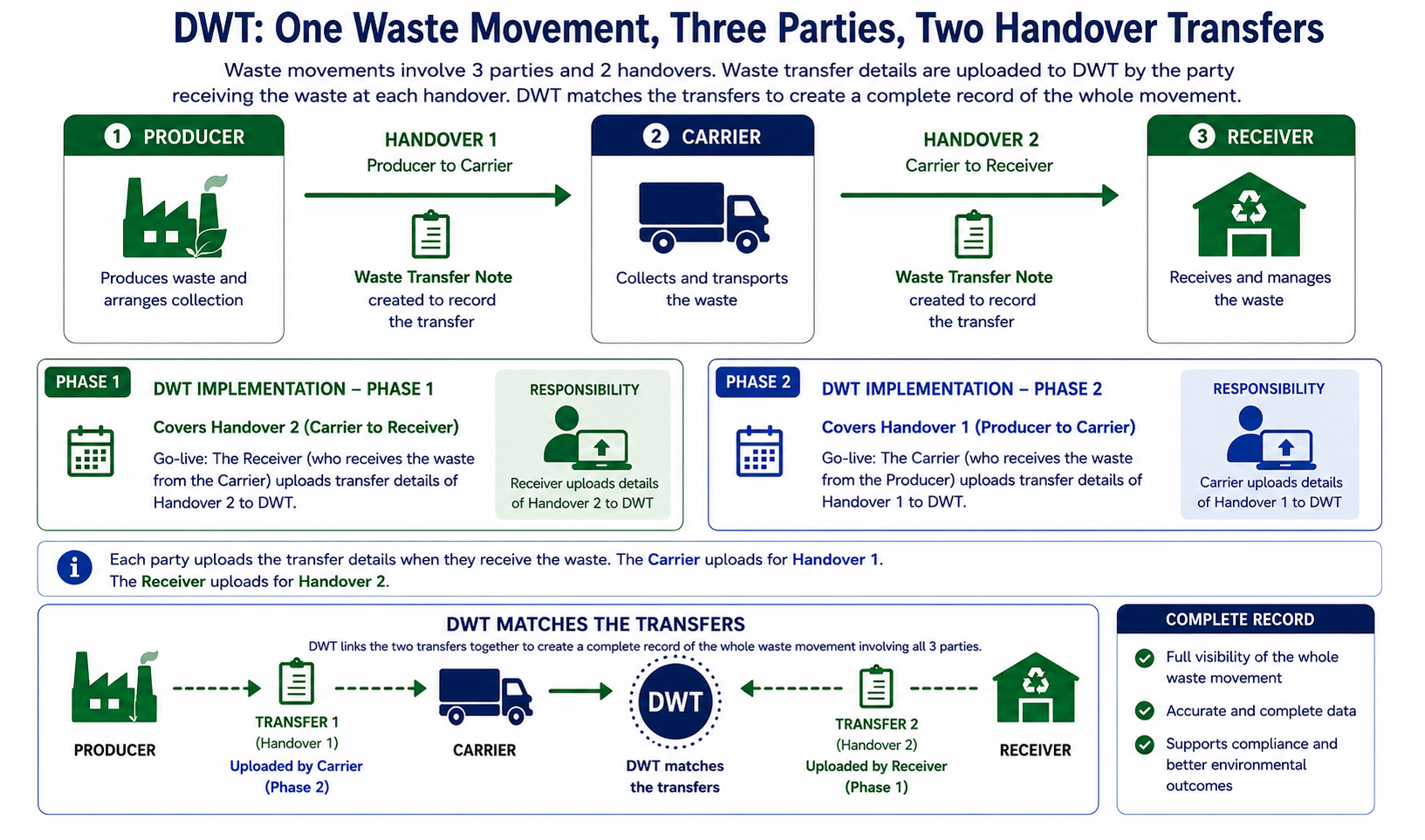
Before anyone can have a sensible conversation about Digital Waste Tracking, it’s worth getting clear on what it actually does — and what it doesn’t. There’s a common misreading that DWT replaces the waste transfer note. It doesn’t. The transfer note still has to exist between the two parties to a transfer, digital or paper, exactly as it does today. What DWT adds is a separate obligation to report the movement to DEFRA. The underlying model — who’s involved, who hands over to whom, who’s responsible for the record — doesn’t change at all.
So let’s start with that model, because once it’s clear, everything DWT does sits neatly on top of it.
So let’s start at the bottom.
Every movement has three parties
Pick any load of waste leaving any premises in the country. There are three roles involved in getting it from where it’s made to where it ends up.
The producer is where the waste starts. The consignor. The business or site that generated it and wants rid of it. In waste regulation this is the party who carries the original duty of care — the legal obligation to make sure the stuff is handled properly all the way to its final destination.
The carrier is whoever collects it and moves it. The registered waste carrier — the company with the licence, the vehicle, the driver. They’re the middle leg.
The receiver is where it lands. The consignee. The transfer station, the treatment site, the landfill, the recycling facility — wherever the waste is going to be processed, recovered or disposed of.
(There’s sometimes a fourth party, the broker or dealer, who arranges the movement without ever touching the waste. They matter legally, but they don’t change the physical journey, so leave them aside for now. We’ll come back to brokers when we get to Phase 2.)
Three parties, but only two transfers
Here’s the bit that often gets muddled. Three parties doesn’t mean three handovers. It means two.
The waste physically changes hands twice:
The first transfer is producer to carrier — the moment the load leaves the producer’s site on the back of the carrier’s vehicle.
The second transfer is carrier to receiver — the moment that vehicle tips at the receiving site.
That’s it. Two points where legal responsibility for the waste passes from one party to another. Everything in the documentation system is built around recording those two moments.
A WTN is just a record of a transfer
Strip away the jargon and a Waste Transfer Note is exactly what it sounds like: a record that a transfer happened. Who handed over what, to whom, when, and what it was.
So if there are two transfers in a movement, there are two transfers to record. In practice that gets handled one of two ways. Either you produce two separate WTNs — one for the producer-to-carrier handover, one for the carrier-to-receiver handover — or you produce a single combined note that covers both legs of the journey. Both are valid. A combined note is common where the carrier and receiver coordinate the paperwork, but legally the requirement is simply that each transfer is documented.
It doesn’t have to be a formal “WTN” form, either. The Environment Agency publishes a template, but you’re not obliged to use it. An invoice, an email, any document will do — as long as it contains the legally required information and is signed by both parties to the transfer.
So who’s actually responsible for producing it?
This is where people tie themselves in knots, and it’s the cleanest part of the whole system once you see it.
The onus sits on both parties to a transfer. Not one or the other. Both.
It genuinely doesn’t matter who physically generates the document. The carrier can produce it. The receiver can produce it. The producer can produce it. What the law cares about is that a record of that transfer exists between the two parties involved, that it’s accurate, and that both of them hold a copy.
That last point is the one that catches businesses out. You don’t get to point at the other party and say “they were doing the paperwork.” If a transfer involving your waste can’t be evidenced, you’re both exposed — regardless of whose job you thought it was. The duty of care under Section 34 of the Environmental Protection Act 1990 lands on each party for their own records.
And those records have to be kept. For non-hazardous waste, the retention period is at least two years from the date of transfer, and that obligation falls on both the party who transferred the waste and the party who received it. An enforcement officer — Environment Agency, SEPA, NIEA depending on where you are — can ask to see them, and “I didn’t keep it” is not a defence.
Where the visibility actually breaks down
Here’s the thing the current system does well: at the level of a single transfer, between two parties who both did their job, the paper trail is sound. Two parties, one shared record, both holding a copy. Clean.
Where it falls apart is when you try to see the whole journey, or look across many movements, or have a regulator try to connect a load that left one site with a load that arrived at another.
Because the paper system has no thread running through it. The producer’s copy and the receiver’s copy are two separate pieces of paper that happen to describe the same waste. Nothing automatically links them. A movement is reconstructed after the fact, by hand, by matching descriptions and dates and tonnages across documents held by different parties in different filing cabinets. If the descriptions don’t quite match, or a note’s gone missing, or someone’s invented their own reference and typo’d it — the chain breaks, and nobody notices until someone goes looking.
That’s the gap. Not that individual records are bad. It’s that there’s no connective tissue between them. The system can tell you a transfer happened, but it can’t easily show you the movement, end to end, as a single linked event. Which means waste crime — the load that leaves a producer and never arrives anywhere legitimate — is hard to spot, because spotting it means somebody manually noticing that two halves of a journey don’t add up.
That is the problem Digital Waste Tracking is built to solve — and it’s worth being precise about how. DWT doesn’t get rid of the transfer note. You’ll still need a record of each transfer between the parties involved, the same as you do now. What DWT adds is a layer above that: a requirement to report the movement into a central DEFRA system, so that the journey exists as one linked digital record rather than two disconnected bits of paper sitting in separate filing cabinets. Same three parties, same two transfers, same underlying duty of care. The note stays. What’s new is that the movement now gets reported, and the regulator can see it end to end.
We’ll get into how that works — and what it asks of each party — in the next post.
Next in this series: what actually has to go on a waste transfer note, including season tickets — the bit everyone gets wrong.